S.08 · Service
AI Chatbot for Ecommerce
An AI chatbot that knows your catalog, your orders, and your return policy.
HOW WE WORK
The process we follow.
- 01
Ingest
We crawl your docs, sitemap, MDX, and uploaded PDFs. Embeddings stored in pgvector or Pinecone.
- 02
Tune
Eval set built from your actual support tickets. We benchmark accuracy + latency + cost across providers before picking the default.
- 03
Embed
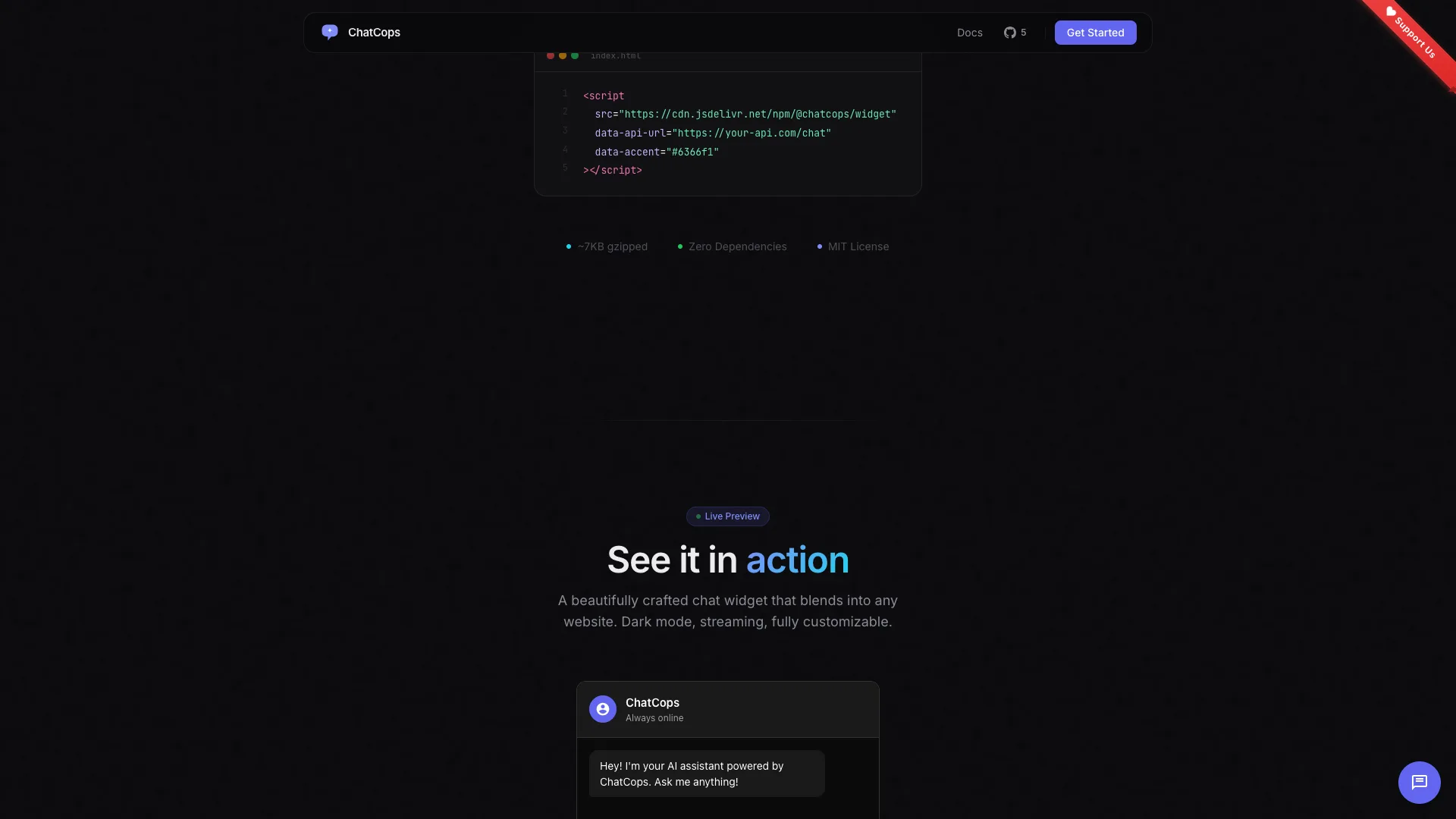
Single <script> tag on your site. Or self-host the widget. Or build it into your app's UI.
- 04
Iterate
Weekly dashboard of asked-but-failed questions. We patch the knowledge base, retrain, redeploy.
Every engagement is scoped and written down before we start.
Brief us →FIELD NOTES
What clients actually said.
“Finding someone who can actually ship LLM features in production is rare. The studio shipped, then helped me hire a verified builder for the rollout.”

Alex Chen
CEO · Lore Protocol
“Working with CODERCOPS was seamless. They understood the nuances of AI-driven interviews and built a product that feels incredibly human. Our users love the realistic experience.”

Sarah Johnson
Founder · PrepAI
“QueryLytic has democratized data access across our organization. Marketing, sales, and ops teams can now get insights without waiting for engineering. CODERCOPS delivered beyond our expectations.”

Michael Torres
CTO · DataFlow Analytics
BILL OF MATERIALS
The stack we trust.
Models
- Claude (Anthropic)
- GPT-4/5 (OpenAI)
- Gemini (Google)
- Llama (open)
Retrieval
- pgvector
- Pinecone
- Qdrant
- Embedding-cache
Frontend
- Vanilla JS widget (~7KB)
- React component
- Custom UI
Hosting
- Cloudflare Workers
- Vercel Edge
- Self-hosted
Boring choices on purpose. Plain-stack code outlives the consultant. If you have a stack already, we'll meet you there.
What we ship
A shopping and support assistant that does the work your storefront FAQ and email inbox can’t: answer real questions about your products, orders, and policies, in the moment, with citations.
Not a chatty mascot. Not a popup that repeats your shipping banner. A working tool that deflects “where’s my order” tickets, answers sizing and spec questions before checkout, and starts the return without a customer waiting on email.
It reads your catalog and your policies, so its answers match what’s actually on the shelf and what your team would actually say.
The four jobs it does
Most ecommerce support and pre-sale questions fall into a handful of buckets. We build the bot around them:
- Product questions. Specs, materials, sizing, compatibility, “will this fit,” “is this waterproof.” Grounded in your product detail pages and spec sheets, with a link back to the product.
- Order status. The customer gives an email or order number, the bot looks up the live record and tells them where the package is. This alone deflects a large share of support volume.
- Returns and refunds. It checks the order against your return window and conditions, explains what qualifies, and starts the return or refund through your store or helpdesk. Out-of-policy cases go to a human.
- Recommendations. When someone describes what they want, it matches against your catalog and points them at real, in-stock products, with size and cross-sell guidance where it helps.
Grounded in your store, not guesses
The failure mode for an ecommerce bot is confident wrong answers: a return window that doesn’t exist, a product that’s discontinued, a spec the model invented. We design against it.
Product and policy replies come from your catalog and help center with sources attached. Order and inventory data is read live from your commerce backend, so the bot never quotes yesterday’s stock. When a question falls outside what it can ground, it says so and offers a handoff instead of filling the gap with plausible fiction.
Connecting to your commerce stack
We wire the bot into where your data already lives. Shopify, WooCommerce, BigCommerce, or a custom backend through its API. Order lookups, inventory, and returns run as tool calls against those systems, and escalations land in Zendesk, Gorgias, Intercom, or your own helpdesk with the full transcript.
If you handle payments or store customer records, we build to your security and compliance requirements and keep to the fundamentals (scoped access, no unnecessary data retention, auditable tool calls). We don’t hold certifications we haven’t earned, and we won’t claim your setup is compliant on our say-so. We build it the way your policies require and document what the bot can touch.
What’s included in every build
- Eval harness. Real questions from your support tickets and pre-sale chats, scored against expected answers. We can show accuracy went up after every prompt change.
- Cost dashboard. Tokens in, tokens out, cost per conversation, per day. No end-of-month API bill surprises.
- Drift monitoring. When you add products or change a policy, accuracy on those topics drops until we re-embed. We catch it automatically.
- Provider abstraction. Moving between Claude, GPT, and Gemini is a config change, not a rewrite. Useful when a provider has an outage during your peak season.
How you will know whether it is working
One number matters, and it is not “conversations handled.” A bot that answers a thousand questions badly has a wonderful conversation count.
We instrument three things from day one. Containment: the share of chats that ended without a human, split out from the ones where the customer gave up. Those are not the same event and reporting them together is how vendors make a bad bot look good. Escalation quality: when a chat does reach your team, did it arrive with the order already looked up and the question summarised, or did the customer have to start over. Answer accuracy on the questions you care about, sampled by a human weekly rather than inferred from thumbs-up clicks, which almost nobody presses.
Expect containment in the region of half of routine volume once order lookups are live, higher for stores whose questions cluster around shipping and returns. We would rather set that expectation now than quote a number from someone else’s case study.
When a chatbot is the wrong answer
If your support volume is a handful of emails a week, this will not pay for itself, and a better FAQ page will do more.
If your catalog data is inconsistent, the bot will faithfully repeat the inconsistency. Fix the source first; a language model over bad data produces confident bad answers rather than obviously bad ones, which is worse.
And if what you actually want is a sales rep who talks people into things, say so. That is a different build, and we would want to talk about whether it is the right thing for your customers before we take it on.
Common questions
Things people ask first.
From your store. We connect to Shopify, WooCommerce, or a custom backend through their APIs, so the bot reads live catalog, inventory, and order records instead of a stale copy. Product answers are grounded in your PDPs and specs, not the model's training data.
It can walk the customer through your returns flow, check eligibility against your policy, and create the return or refund via tool-calling into your store or helpdesk. For anything outside policy, it hands off to a human with the full conversation attached.
It reads live inventory, so it tells the customer the truth and can suggest in-stock alternatives from the same category or a close size. No phantom availability.
No. Product and policy answers are pulled from your catalog and help center with citations. If something is not covered, it says so and offers a handoff rather than guessing at a return window or a discount.
It matches the shopper's stated need against your catalog (attributes, categories, price, reviews) and can factor in the current cart or order history when it has access. Recommendations link straight to the product page.