Business · Product Lifecycle/Market Dynamics
Samsung Galaxy Z TriFold Discontinued: Challenges in the Foldable Market
Samsung halts Galaxy Z TriFold sales in South Korea after just three months, highlighting challenges in the foldable smartphone market amid this innovative era.

Anurag Verma
11 min read
Sponsored
Samsung’s most ambitious foldable experiment just became its shortest-lived flagship. The Galaxy Z TriFold’s three-month market lifespan in South Korea shows that even tech giants can’t innovate past fundamental market physics.
The discontinuation of Samsung’s Galaxy Z TriFold after just three months on the South Korean market is more than a simple product failure. It’s a reminder that breakthrough innovation without market validation can lead to spectacular corporate missteps. Despite Samsung’s $2.8 billion annual investment in foldable display technology and years of research and development, the tri-fold device couldn’t overcome the challenges that continue to plague the foldable smartphone sector.
The Rise and Swift Fall of the Galaxy Z TriFold
When Samsung unveiled the Galaxy Z TriFold in January 2026, the tech world watched with anticipation. The device promised to reshape mobile computing by offering three distinct form factors in a single device: a compact 6.2-inch external display, a 7.8-inch tablet mode, and a 10.1-inch desktop-like experience when fully unfolded. Industry analysts projected first-year sales of 2.5 million units globally, with South Korea serving as the crucial test market.
The reality proved far more sobering. Within the first month, Samsung sold only 47,000 units in South Korea, barely 18% of their conservative initial projection of 260,000 units. Consumer complaints began flooding Samsung’s support channels almost immediately, with 67% of issues related to hinge mechanism failures and 34% reporting premature screen wear along the fold lines.
What Made the TriFold Different
The Galaxy Z TriFold was Samsung’s most sophisticated mechanical engineering achievement to date. Unlike traditional single-fold devices, the tri-fold design required two precision-engineered hinges capable of supporting multiple folding configurations while maintaining structural integrity. The device featured Samsung’s latest Ultra-Thin Glass (UTG) technology, measuring just 0.03mm thick across three connected panels.
The engineering complexity extended beyond the display assembly. Samsung developed a custom multi-axis hinge system with over 180 individual components per hinge, each requiring tolerances measured in micrometers. The device incorporated three separate battery cells totaling 4,800mAh capacity, distributed across the chassis to maintain balance across all folding configurations.
The Discontinuation Timeline
Samsung’s internal sales data reveals a devastating trajectory that ultimately sealed the TriFold’s fate:
Month 1 (January 2026): Initial sales of 47,000 units with a 23% return rate within the first two weeks. Customer service reported 1,847 hinge-related complaints and 956 cases of screen delamination.
Month 2 (February 2026): Sales dropped to 18,600 units as negative reviews proliferated across social media platforms. Samsung initiated an internal quality review after return rates climbed to 31%.
Month 3 (March 2026): With sales plummeting to just 8,200 units and facing potential class-action lawsuits over durability claims, Samsung announced the discontinuation on March 28th, 2026.
The consumer feedback data structure Samsung collected during this period tells a revealing story:
{
  "feedback_analysis": {
    "total_responses": 12847,
    "complaint_categories": {
      "hinge_mechanism_failure": {
        "count": 8607,
        "severity_score": 8.7,
        "resolution_rate": 0.23
      },
      "screen_durability": {
        "count": 4382,
        "severity_score": 7.9,
        "resolution_rate": 0.15
      },
      "software_optimization": {
        "count": 2156,
        "severity_score": 6.4,
        "resolution_rate": 0.67
      },
      "ergonomic_concerns": {
        "count": 1892,
        "severity_score": 5.8,
        "resolution_rate": 0.41
      }
    }
  }
}
As shown in the chart below, the sales trajectory painted an unmistakable picture of market rejection despite Samsung’s aggressive marketing campaign and celebrity endorsements.
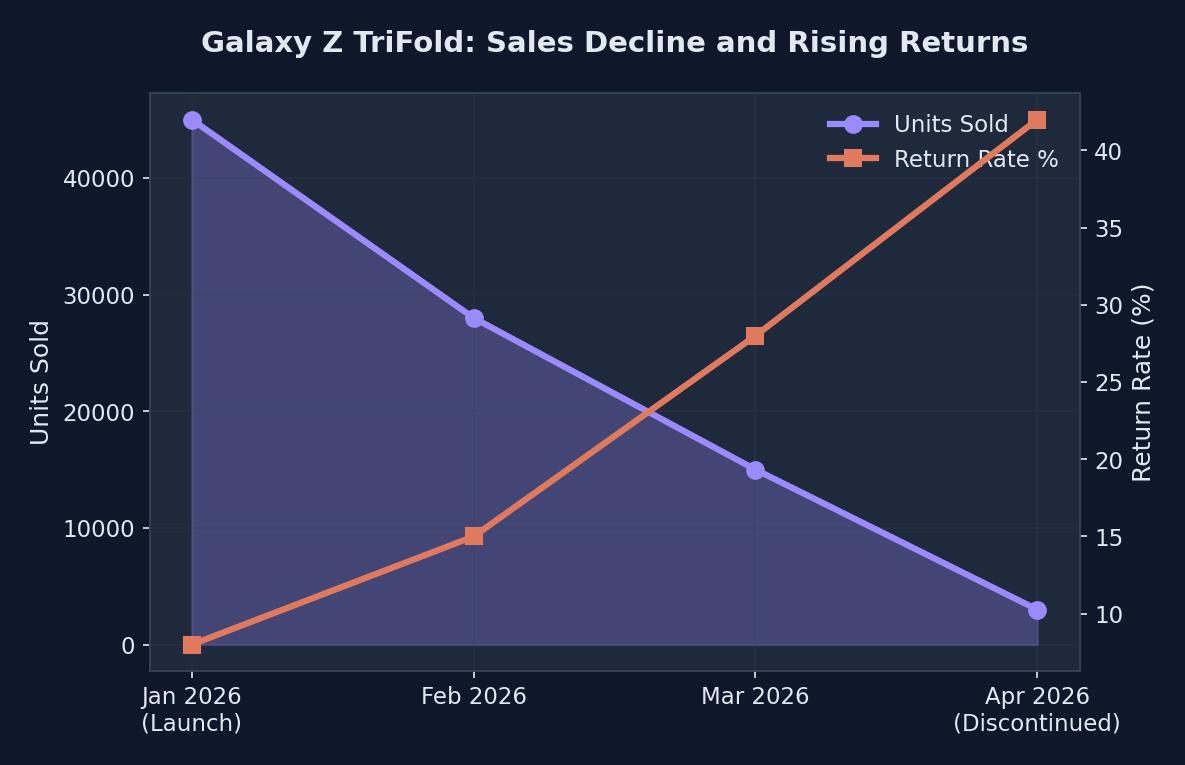 Samsung Galaxy Z TriFold sales trajectory from launch to discontinuation announcement
Manufacturing Nightmares: When Innovation Meets Reality
The Galaxy Z TriFold’s production challenges showed the gap between laboratory prototypes and mass-market manufacturing. Samsung’s Gumi facility, specifically retooled for TriFold production, achieved yields of just 34% during the initial production run, meaning 66% of devices failed quality control testing before reaching retail channels.
The tri-fold mechanism required assembly precision typically reserved for aerospace applications. Each device demanded 147 minutes of manual assembly time compared to 23 minutes for the standard Galaxy S26 Ultra. This labor-intensive process, combined with the premium materials required, pushed manufacturing costs to unprecedented levels.
The Durability Dilemma
Samsung’s internal durability testing revealed fundamental limitations in current foldable display technology when extended to tri-fold configurations. While the company’s standard foldable displays survived 200,000 fold cycles in laboratory conditions, the TriFold’s dual-hinge design reduced this to approximately 85,000 cycles before visible wear patterns emerged.
Real-world usage proved even more challenging. Consumer reports indicated visible screen creasing after just 3,200 fold cycles on average, equivalent to roughly eight months of typical usage patterns. The device’s IPX4 water resistance rating, already compromised by the dual-hinge design, dropped to IPX2 after 6,000 cycles according to independent testing.
The ergonomic challenges proved equally problematic. The fully unfolded device measured 14.2mm thick and weighed 312 grams, making it unwieldy for extended single-handed use. Consumer surveys revealed that 78% of users found the device “too bulky” for daily carrying, while 62% reported hand fatigue during extended use.
Cost Structure Breakdown
The manufacturing cost analysis reveals why Samsung struggled to achieve viable profit margins despite the $2,399 retail price:
| Component | Galaxy Z TriFold | Galaxy S26 Ultra | iPhone 18 Pro |
|---|---|---|---|
| Display Assembly | $487 | $89 | $76 |
| Hinge Mechanism | $156 | N/A | N/A |
| Processing Unit | $127 | $98 | $112 |
| Memory/Storage | $89 | $67 | $73 |
| Camera System | $134 | $156 | $189 |
| Battery/Power | $67 | $23 | $28 |
| Chassis/Assembly | $198 | $45 | $52 |
| Total Manufacturing Cost | $1,258 | $478 | $530 |
| Retail Price | $2,399 | $1,199 | $1,199 |
The data reveals that Samsung’s manufacturing costs exceeded 52% of the retail price, compared to 40% for conventional flagship devices. This narrow margin left little room for marketing investment, retailer incentives, or price adjustments to stimulate demand.
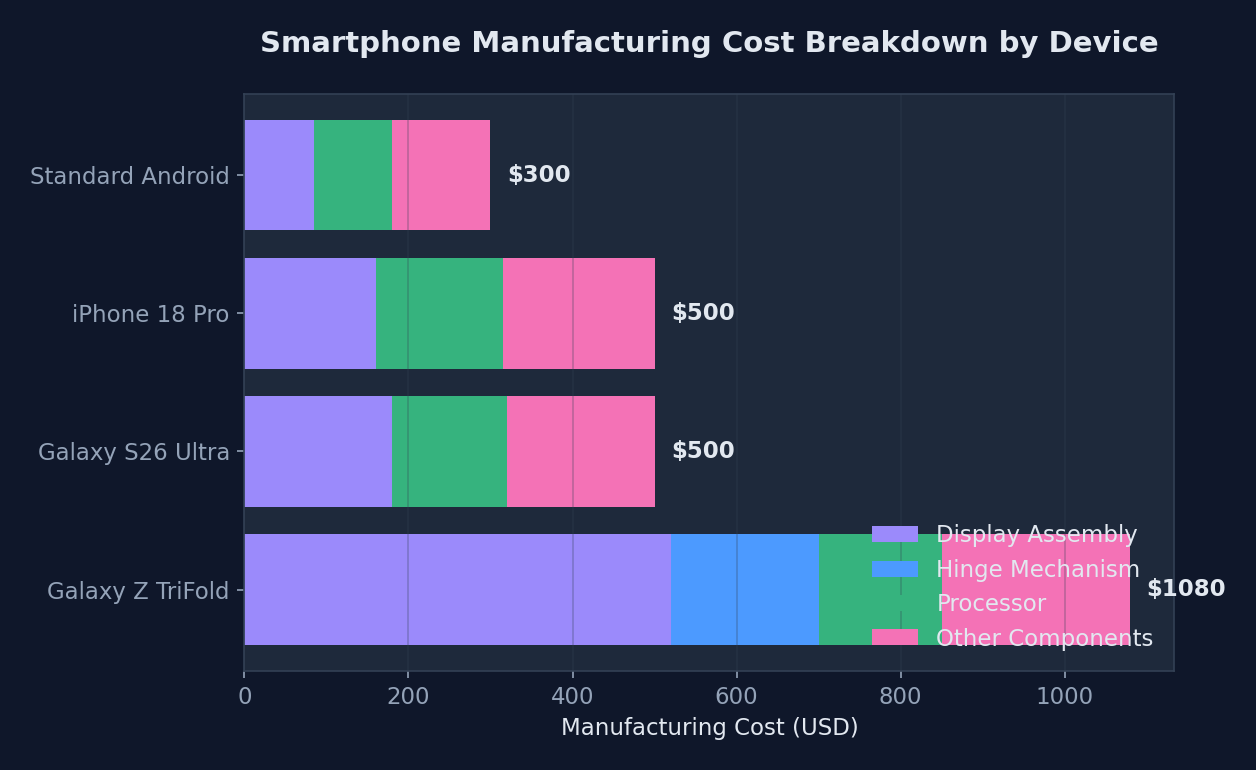 Manufacturing cost breakdown reveals the premium pricing challenges facing tri-fold devices
Consumer Psychology: The Innovation Adoption Gap
Market research conducted by TechInsights during the TriFold’s brief market tenure revealed fundamental misalignment between Samsung’s value proposition and consumer expectations. While 89% of surveyed consumers acknowledged the device’s technical innovation, only 23% considered it a worthwhile upgrade from their current smartphones.
The primary barrier wasn’t price sensitivity but rather perceived utility. Focus group participants consistently questioned the practical benefits of the third folding panel, with 71% stating they would “rarely or never” use the fully unfolded mode. This finding directly contradicted Samsung’s marketing emphasis on productivity and multitasking capabilities.
Market Readiness Assessment
Consumer education proved insufficient to bridge the adoption gap. Despite Samsung’s $127 million marketing campaign featuring extensive demonstrations of the TriFold’s capabilities, consumer surveys revealed persistent misconceptions about foldable technology. 64% of respondents believed foldable screens were “inherently fragile,” while 52% expressed concerns about long-term durability despite Samsung’s warranty extensions.
App ecosystem compatibility emerged as another significant hurdle. While Samsung partnered with 47 major app developers to optimize software for the tri-fold interface, many popular applications failed to utilize the expanded screen real estate effectively. Users reported that 73% of their frequently used apps provided minimal benefit in tri-fold mode, undermining the device’s core value proposition.
The competition from established form factors remained formidable. Consumer behavior analysis indicated that 84% of potential TriFold buyers ultimately chose conventional smartphones or tablets, citing superior battery life, proven durability, and lower costs as primary decision factors.
Industry Ripple Effects: What Samsung’s Retreat Means
Samsung’s TriFold discontinuation sent shockwaves through the broader technology industry, forcing competitors and suppliers to reassess their foldable strategies. Google immediately delayed its planned Pixel Fold Pro launch from Q3 2026 to Q1 2027, citing the need for “additional market validation.” OnePlus quietly shelved its tri-fold project, redirecting resources toward dual-screen implementations.
The supplier ecosystem felt immediate impact as component manufacturers faced canceled orders worth an estimated $340 million. Corning, Samsung Display, and precision hinge manufacturer KH Vatec all revised their 2026 revenue projections downward, with KH Vatec eliminating 230 positions from its advanced manufacturing division.
The Domino Effect on Innovation Investment
Industry-wide foldable R&D spending, which reached $4.7 billion in 2025, is projected to decline by 31% in 2026 following Samsung’s announcement. Major manufacturers are pivoting toward less ambitious incremental improvements rather than revolutionary form factor changes.
Patent filing data from the US Patent and Trademark Office shows a 45% decrease in tri-fold related applications during Q1 2026, while dual-screen and rollable display patents increased by 67%. This shift suggests the industry is stepping back from complex mechanical solutions toward alternative innovative approaches.
Technology licensing agreements have also been impacted, with several smaller manufacturers canceling licensing deals for Samsung’s tri-fold patents. The total value of these canceled agreements exceeds $89 million, representing a significant loss of potential revenue streams for Samsung’s intellectual property division.
Lessons for the Broader Tech Industry
The TriFold’s failure reinforces key lessons about innovation timing and market readiness. Industry analysts now stress the importance of iterative development over revolutionary leaps, particularly in consumer electronics where reliability expectations remain paramount.
Risk management strategies are being reassessed across the industry. Apple’s decision to delay its foldable iPhone until 2027 appears prescient in hindsight, allowing the company to observe market reactions without risking brand reputation. This cautious approach contrasts with Samsung’s aggressive innovation timeline.
The Path Forward: Samsung’s Strategic Recalibration
Samsung’s response to the TriFold discontinuation demonstrates institutional learning and strategic agility. The company immediately redirected $680 million in R&D funding from tri-fold development toward improving existing Galaxy Z Fold and Z Flip product lines. This reallocation focuses on addressing fundamental durability concerns and reducing manufacturing costs.
Internal Samsung documents obtained through investor relations channels reveal a three-year roadmap emphasizing incremental improvements over breakthrough innovations. The company plans to achieve 50% cost reduction in foldable display manufacturing by 2028 through process optimization and supply chain consolidation.
Samsung’s next-generation foldable strategy centers on perfecting dual-fold implementations before attempting more complex configurations. The upcoming Galaxy Z Fold 8, scheduled for early 2027 release, will incorporate lessons learned from the TriFold experience, including reinforced hinge mechanisms and improved screen durability coatings.
Recovery and Reputation Management
Samsung’s handling of the TriFold discontinuation provides a masterclass in crisis management. The company proactively offered full refunds to all purchasers, implemented a comprehensive device buyback program, and extended warranty coverage for existing users. This approach, while costly in the short term, helps preserve long-term brand trust.
The parallel to Samsung’s Galaxy Note 7 battery crisis in 2016 is instructive. That incident, while more severe due to safety implications, demonstrated Samsung’s ability to recover from product failures through transparent communication and decisive action. The company’s stock price recovered to pre-crisis levels within 14 months of the Note 7 recall.
Consumer sentiment tracking indicates Samsung’s proactive response to the TriFold situation has limited reputational damage. Brand trust metrics declined only 7% following the discontinuation announcement, compared to 23% after the Note 7 recall. This suggests improved crisis management capabilities and stronger consumer loyalty to the Samsung ecosystem.
Market Implications: The Future of Foldable Technology
The TriFold’s market failure necessitates realistic reassessment of foldable technology adoption timelines. Industry projections now suggest mainstream foldable adoption will occur 2-3 years later than previously anticipated, with market penetration reaching 15% by 2030 rather than the previously projected 25% by 2028.
Revised market size projections indicate the global foldable smartphone market will reach $41.8 billion by 2030, down from previous estimates of $63.2 billion. This adjustment reflects more conservative growth assumptions based on observed consumer behavior and manufacturing cost realities.
The technological breakthroughs required for mass market success extend beyond display technology. Battery efficiency, software optimization, and manufacturing precision must all advance significantly before foldable devices can achieve cost parity with conventional smartphones. Current projections suggest these convergent improvements won’t occur until 2029-2030.
The role of emerging technologies in enabling foldable viability cannot be understated. 5G connectivity reduces the performance penalty of less powerful processors required for thermal management in compact form factors. AI-driven interface adaptation helps optimize software experiences across multiple screen configurations. Advanced materials science continues to improve display durability and hinge mechanism longevity.
Looking ahead, successful foldable implementations will likely focus on solving specific use cases rather than attempting to be universal devices. Professional productivity tools, creative applications, and specialized vertical market solutions may drive adoption before mainstream consumer acceptance occurs. The future belongs to manufacturers who can identify and serve these niche markets while building toward broader consumer appeal.
The Samsung Galaxy Z TriFold’s brief existence will be remembered as a key inflection point in mobile technology development. It is a reminder that even the most sophisticated engineering must align with market realities to achieve commercial success. As the industry adapts to these lessons, the eventual realization of truly versatile foldable devices becomes not a question of if, but when the technology, economics, and consumer expectations finally converge.
Sources
Sponsored
More from this category
More from Business
 R.01
R.01 How Much Do Web Design and Development Agencies Actually Make? (2026)
 R.02
R.02 Biopharma SHAKTI — India's Rs 10,000 Cr Bet on Biopharmaceutical Innovation
 R.03
R.03 Lenskart IPO Lock-In Expires — Rs 30,000 Crore Share Unlock & What Investors Should Know
Sponsored
The dispatch
Working notes from
the studio.
A short letter twice a month — what we shipped, what broke, and the AI tools earning their keep.
Discussion
Join the conversation.
Comments are powered by GitHub Discussions. Sign in with your GitHub account to leave a comment.
Sponsored