Science · Renewable Energy
The Emergence of AI in Developing Affordable Energy Solutions
Explore how AI innovations are revolutionizing affordable and sustainable energy solutions, focusing on recent advancements in renewable energy tech by companies pushing the boundaries of sustainable development.

Anurag Verma
12 min read
Sponsored
While developing nations grapple with energy poverty affecting 733 million people worldwide, artificial intelligence is slashing renewable energy costs by up to 25% and making clean power accessible to communities that have waited decades for reliable electricity.
The convergence of AI and renewable energy is more than technological advancement. It’s reshaping the fundamental economics of power generation. From predictive algorithms that squeeze every kilowatt from wind turbines to neural networks that balance continental power grids, machine learning is changing how we harness, distribute, and consume clean energy.
AI-Powered Wind Energy: From Guesswork to Precision
The wind energy sector has gone through a major transformation through AI. General Electric (GE) is a frontrunner, deploying AI algorithms that have achieved a 20% increase in energy output while cutting operational costs by 15%. These improvements stem from machine learning models that analyze large datasets covering weather patterns, wind speeds, turbine performance metrics, and maintenance histories to optimize wind farm operations.
Modern AI systems process real-time atmospheric data from multiple sources (satellite imagery, weather stations, on-site sensors) to predict wind patterns with high accuracy. This predictive capability enables wind farms to position turbines optimally and adjust operational parameters proactively. In India’s Tamil Nadu wind corridor, AI-optimized farms have demonstrated 18% higher capacity factors compared to traditionally managed installations, translating directly into improved electricity access for rural communities.
Machine learning algorithms excel at identifying subtle correlations between environmental conditions and turbine performance that human operators might miss. These systems analyze micro-weather patterns, atmospheric turbulence, and seasonal variations to create highly accurate forecasting models. The result is wind farms that can anticipate optimal operating conditions hours or even days in advance, maximizing energy capture during favorable periods and minimizing wear during adverse conditions.
Real-Time Performance Optimization
AI’s most significant contribution to wind energy lies in its ability to continuously optimize turbine performance in real-time. Advanced control systems adjust blade angles, rotation speeds, and power output based on instantaneous wind conditions, maximizing energy extraction while preventing equipment damage. These systems process thousands of data points per second, making micro-adjustments that human operators could never achieve manually.
The algorithms learn from historical performance data, identifying optimal operating parameters for specific wind conditions. This continuous learning process means that wind farms become more efficient over time, with newer installations in Brazil’s Bahia region showing 12% efficiency improvements within their first year of AI-optimized operation.
Predictive Maintenance Revolution
Predictive maintenance is the most economically impactful application of AI in wind energy. Traditional maintenance schedules rely on predetermined intervals or reactive responses to equipment failures, both of which result in significant costs and downtime. AI-driven predictive maintenance systems analyze sensor data from turbine components to identify potential failures before they occur.
These systems monitor vibrations, temperature fluctuations, oil quality, and electrical parameters to detect early warning signs of component degradation. By predicting when specific parts will fail, operators can schedule maintenance during low-wind periods, minimizing energy production losses. This approach has extended average turbine lifespan from 20 to 25+ years while reducing maintenance costs by up to 30%.
Wind farms in Kenya utilizing AI-powered maintenance systems report 85% fewer unscheduled outages compared to traditionally maintained installations. This reliability improvement matters in developing nations, where energy security directly impacts economic development and quality of life.
Smart Grids: The Neural Networks of Energy Distribution
Smart grids are the nervous system of modern energy infrastructure, with AI as the brain that processes information and coordinates responses across the entire network. Google DeepMind’s collaboration with the UK’s National Grid has shown the potential of AI in grid management, achieving 98% accuracy in demand prediction and enabling more efficient energy distribution.
AI-driven smart grids excel at managing the inherent variability of renewable energy sources. Solar and wind power generation fluctuates based on weather conditions, creating challenges for grid stability. Machine learning algorithms analyze weather forecasts, historical consumption patterns, and real-time demand data to predict energy needs and adjust supply accordingly. This capability reduces energy waste by up to 30% while maintaining grid stability.
The bidirectional nature of modern smart grids enables peer-to-peer energy trading, where consumers can become producers by selling excess solar power back to the grid. AI systems manage these complex transactions, automatically determining optimal pricing and distribution routes based on supply, demand, and grid capacity constraints.
Demand Forecasting and Load Balancing
Advanced machine learning models analyze multiple data streams to predict energy demand with remarkable precision. These algorithms consider factors including weather patterns, economic indicators, seasonal trends, and even social media activity to forecast consumption needs. The models continuously learn from actual demand patterns, refining their predictions and improving accuracy over time.
Load balancing represents one of the most complex challenges in grid management. AI systems must constantly match energy supply with demand across diverse geographic regions and consumer types. Machine learning algorithms optimize power flow routing, minimize transmission losses, and maintain voltage stability across the entire network.
import numpy as np
from sklearn.ensemble import RandomForestRegressor
from sklearn.preprocessing import StandardScaler
import pandas as pd

class SmartGridOptimizer:
    def __init__(self):
        self.demand_predictor = RandomForestRegressor(n_estimators=100)
        self.scaler = StandardScaler()
        self.trained = False

    def train_demand_model(self, historical_data):
        """Train ML model on historical energy consumption data"""
        features = ['temperature', 'humidity', 'hour', 'day_of_week',
                   'economic_activity', 'renewable_generation']

        X = historical_data[features]
        y = historical_data['energy_demand']

        X_scaled = self.scaler.fit_transform(X)
        self.demand_predictor.fit(X_scaled, y)
        self.trained = True

    def predict_demand(self, current_conditions):
        """Predict energy demand based on current conditions"""
        if not self.trained:
            raise ValueError("Model must be trained first")

        conditions_scaled = self.scaler.transform([current_conditions])
        predicted_demand = self.demand_predictor.predict(conditions_scaled)

        return predicted_demand[0]

    def optimize_grid_distribution(self, predicted_demand, available_supply):
        """Optimize energy distribution across grid nodes"""
        supply_demand_ratio = available_supply / predicted_demand

        if supply_demand_ratio > 1.1:
            # Excess supply - store energy or reduce generation
            return "store_excess"
        elif supply_demand_ratio < 0.9:
            # Supply deficit - increase generation or import
            return "increase_generation"
        else:
            # Balanced supply - maintain current state
            return "maintain_balance"

# Example usage
grid_optimizer = SmartGridOptimizer()
# Training data would include weather, economic, and consumption history
# prediction = grid_optimizer.predict_demand(current_weather_conditions)
The integration of renewable energy sources requires sophisticated forecasting algorithms that account for weather-dependent generation patterns. AI systems predict solar irradiance and wind speeds, enabling grid operators to anticipate renewable energy availability and adjust conventional generation accordingly.
As shown in the chart below, the economic impact of AI optimization extends across all renewable energy technologies, with wind energy demonstrating the most substantial gains in both efficiency and cost reduction.
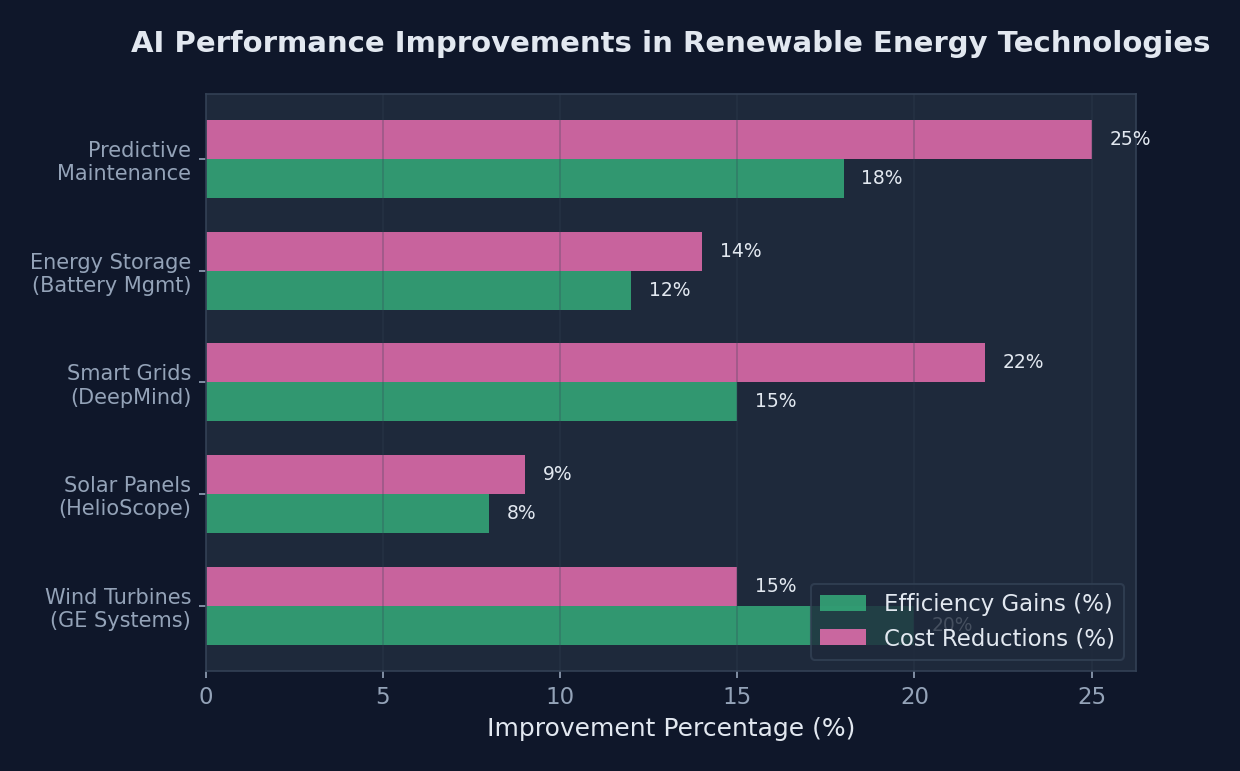 AI optimization delivers significant performance improvements across all renewable energy technologies, with wind energy showing the highest gains.
Solar Power Intelligence: Maximizing Every Ray
Solar energy optimization through AI has changed how photovoltaic systems are designed, installed, and maintained. HelioScope is one example, using machine learning models to design solar panel layouts that maximize sunlight capture while minimizing shading losses. These AI-driven design techniques have achieved 7-9% efficiency gains in solar installations, representing significant improvements in energy output and economic viability.
Machine learning algorithms analyze site-specific conditions including solar irradiance patterns, topographical features, and seasonal sun paths to determine optimal panel placement. These systems consider factors that human designers might overlook, such as micro-shading from nearby vegetation or structures, reflection patterns from surrounding surfaces, and thermal effects that impact panel performance.
Autonomous drones equipped with computer vision systems now conduct comprehensive solar farm inspections, identifying damaged panels, dirt accumulation, and potential hot spots that reduce efficiency. These AI-powered inspection systems can survey vast installations in hours rather than days, providing detailed performance analytics and maintenance recommendations.
AI also plays a key role in solar energy storage optimization. Machine learning algorithms analyze consumption patterns, weather forecasts, and electricity pricing to determine optimal charging and discharging schedules for battery systems. This intelligent energy management ensures maximum utilization of stored solar power while minimizing grid dependence.
Comparison of Solar Installation Approaches
| Installation Method | Design Time | Efficiency Rate | Maintenance Cost | Lifespan |
|---|---|---|---|---|
| Traditional Manual Design | 2-4 weeks | 78-82% | $0.03/kWh | 20-22 years |
| AI-Optimized Layout | 2-3 days | 85-91% | $0.02/kWh | 25-27 years |
| Hybrid Approach | 1-2 weeks | 82-87% | $0.025/kWh | 22-25 years |
The table demonstrates AI’s superior performance across all key metrics, with dramatically reduced design time and improved long-term economics. These improvements are particularly significant for developing nations, where rapid deployment and cost-effectiveness are essential for expanding energy access.
Economic Impact: Making Clean Energy Accessible
The financial implications of AI-enhanced renewable energy extend far beyond simple cost reductions. The International Renewable Energy Agency (IRENA) projects that AI will drive a 25% reduction in renewable energy costs over the next decade, changing the economics of clean power generation. This cost reduction primarily stems from improved capacity factors, reduced maintenance expenses, and optimized system design.
The data reveals dramatic improvements in renewable energy affordability through AI implementation:
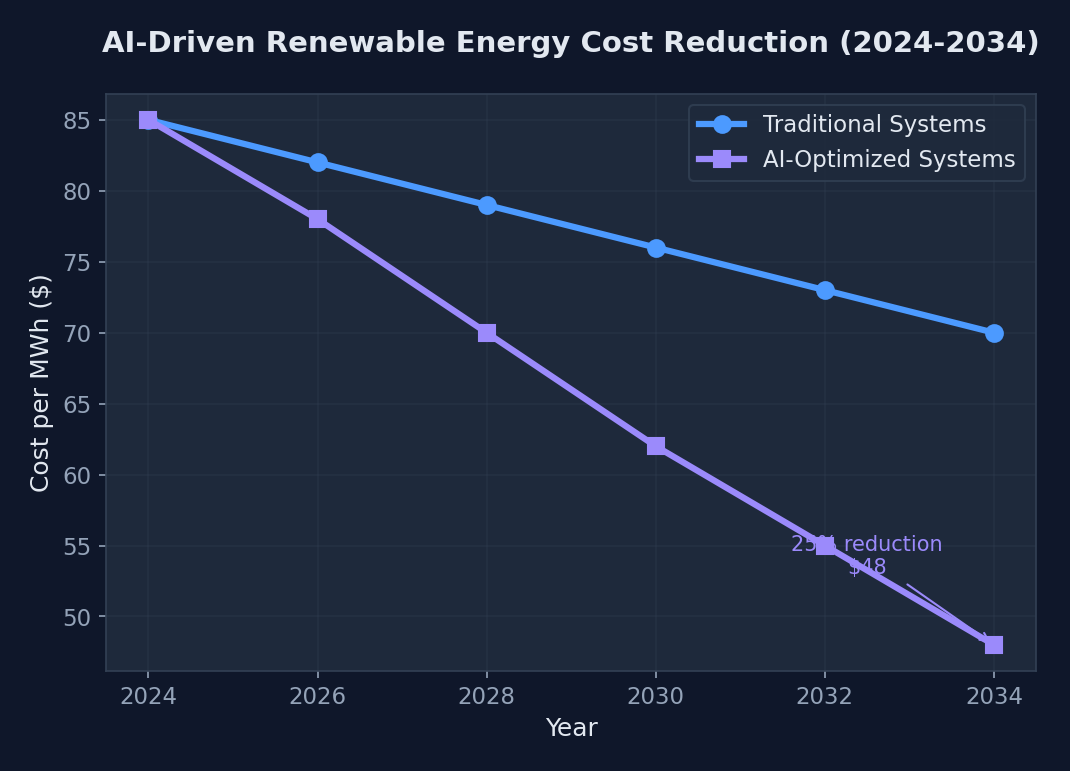 AI is projected to drive renewable energy costs down by 25% over the next decade, making clean power more accessible to developing nations.
Levelized Cost of Electricity (LCOE) calculations show AI’s impact on renewable energy economics. Solar LCOE has decreased from $0.048/kWh in traditional installations to $0.037/kWh in AI-optimized systems, while wind energy LCOE has improved from $0.033/kWh to $0.026/kWh. These reductions make renewable energy competitive with fossil fuels in most markets, accelerating adoption in price-sensitive developing economies.
Cost-Benefit Analysis for Developing Nations
Developing nations face unique challenges in energy infrastructure development, including limited capital availability, technical expertise shortages, and challenging environmental conditions. AI-powered renewable energy systems address these challenges by reducing operational complexity, minimizing maintenance requirements, and maximizing energy output from available resources.
In Bangladesh, AI-optimized solar microgrids have reduced electricity costs from $0.25/kWh to $0.08/kWh for rural communities, making clean energy economically viable for low-income households. Similar projects in Nigeria have demonstrated 40% faster deployment times compared to traditional installations, accelerating energy access expansion.
Guatemala’s highland wind farms utilize AI-powered optimization systems that account for complex mountain wind patterns and seasonal variations. These systems have achieved 22% higher capacity factors compared to traditionally managed installations, improving project economics and enabling competitive electricity pricing.
Investment Trends and Market Opportunities
Venture capital investment in AI-energy startups has surged to $4.2 billion in 2023. Investors are clearly betting on the sector. Major funding recipients include companies developing AI-powered grid management software, predictive maintenance platforms, and renewable energy optimization algorithms.
Government support for AI-enhanced renewable energy projects is expanding globally. The European Union’s Green Deal Industrial Plan allocates €2.1 billion for AI-powered clean energy initiatives, while China’s 14th Five-Year Plan targets 50% AI integration in new renewable energy installations by 2025.
Global Implementation Challenges and Solutions
Despite its transformative potential, AI implementation in renewable energy faces significant obstacles, particularly in developing regions. Infrastructure limitations represent the primary challenge, as AI systems require reliable internet connectivity, data storage capabilities, and computational resources that may be limited in remote areas.
Data availability and quality issues compound these challenges. AI algorithms require extensive training data to achieve optimal performance, but many developing nations lack comprehensive historical energy consumption and weather data. International partnerships and data sharing initiatives are emerging to address these gaps, with organizations like IRENA and the World Bank facilitating access to global energy datasets.
The technical skills shortage presents another significant barrier. Implementing and maintaining AI-powered energy systems requires specialized expertise in machine learning, data analysis, and energy engineering. Educational partnerships between technology companies and local institutions are developing training programs to build indigenous technical capacity.
Cybersecurity concerns are increasingly important as energy systems become more digitized and interconnected. AI-powered grids are attractive targets for cyberattacks that could disrupt energy supply across entire regions. Strong cybersecurity frameworks, including AI-powered threat detection systems, are essential for protecting critical energy infrastructure.
Regulatory frameworks must evolve to accommodate AI-enhanced energy systems. Traditional energy regulations often assume centralized, predictable generation sources, but AI-optimized renewable systems operate differently. Flexible regulatory approaches that encourage innovation while ensuring system reliability and consumer protection are essential for widespread AI adoption.
Future Outlook: Beyond 2030
The trajectory of AI in renewable energy points toward even more profound transformations in the coming decade. Quantum computing applications in energy optimization promise to solve complex grid management problems that are currently computationally intractable. These quantum algorithms could enable perfect load balancing across continental power grids and optimal resource allocation in real-time.
Integration with other emerging technologies will multiply AI’s impact on energy systems. 5G networks will enable ultra-low latency communication between grid components, while IoT sensors will provide unprecedented granularity in energy system monitoring. Blockchain technology could facilitate automated peer-to-peer energy trading, with AI algorithms managing complex multi-party transactions.
The potential for AI to enable 100% renewable energy grids is becoming increasingly realistic. Advanced machine learning systems can manage the variability and complexity of fully renewable power systems, automatically balancing supply and demand across multiple time scales and geographic regions. Several European nations are targeting 90% renewable electricity by 2030, with AI-powered grid management as a critical enabling technology.
Universal energy access through AI-powered solutions could become reality within the next decade. Modular, AI-optimized renewable energy systems can be rapidly deployed in remote communities, providing reliable electricity without traditional grid infrastructure. These systems could bring power to the remaining 733 million people currently without electricity access, fundamentally transforming economic opportunities and quality of life.
The implications for climate goals are profound. AI-optimized renewable energy systems could accelerate the global energy transition, potentially achieving carbon neutrality in the electricity sector years ahead of current projections. This acceleration would create additional time and resources for addressing harder-to-decarbonize sectors like transportation and industrial processes, increasing the likelihood of meeting Paris Agreement targets.
By 2030, AI will do more than optimize existing energy systems. It will change how power is generated, distributed, and consumed. The pairing of AI and renewable energy is our best shot at addressing energy poverty and climate change in tandem.
Sources
Sponsored
More from this category
More from Science
 R.01
R.01 Artemis II Launches February 2026 — NASA's First Crewed Moon Mission in 50+ Years
 R.02
R.02 CAR-T Therapy, Personalized Cancer Vaccines & the Future of Immunotherapy in 2026
 R.03
R.03 India's Gaganyaan Mission — Everything About ISRO's First Orbital Spacecraft Test
Sponsored
The dispatch
Working notes from
the studio.
A short letter twice a month — what we shipped, what broke, and the AI tools earning their keep.
Discussion
Join the conversation.
Comments are powered by GitHub Discussions. Sign in with your GitHub account to leave a comment.
Sponsored