Career · Growth
Developer Career Paths in 2026 — IC, Management, and Everything In Between
The traditional developer career ladder is fragmenting. IC tracks, management, staff-plus roles, and hybrid paths offer different ways to grow. Here's how to navigate them.

Anurag Verma
8 min read
Sponsored
The days of “write code until you become a manager” are over. Developer careers have diversified into multiple paths, each with distinct skills, responsibilities, and rewards.
Understanding these paths helps you make intentional decisions rather than drifting into roles that do not fit.
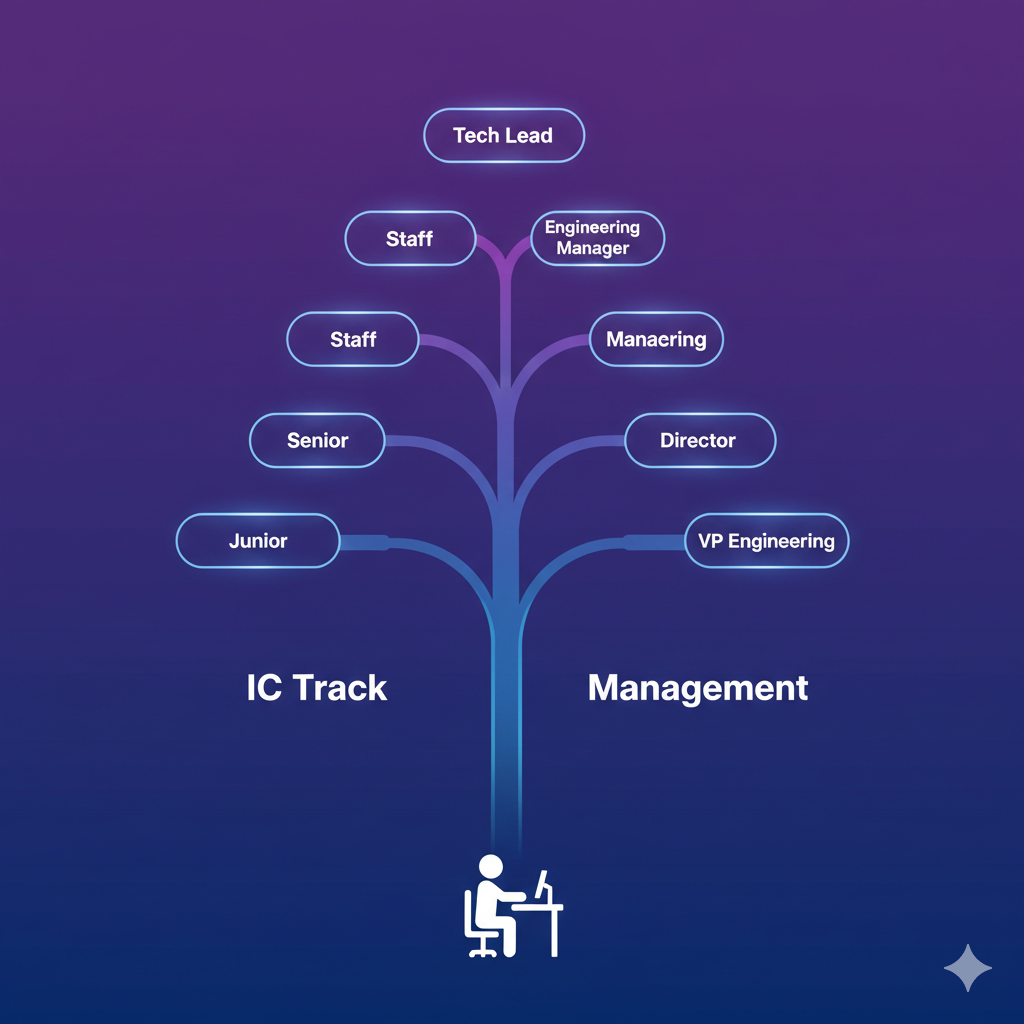
Career progression is no longer a single ladder. It’s a lattice of possibilities
The Career Landscape
Modern tech companies offer multiple tracks:
Career Paths in 2026
├── Individual Contributor (IC) Track
│   ├── Junior Developer
│   ├── Developer
│   ├── Senior Developer
│   ├── Staff Developer
│   ├── Principal Developer
│   └── Distinguished Developer / Fellow
│
├── Management Track
│   ├── Tech Lead
│   ├── Engineering Manager
│   ├── Senior Engineering Manager
│   ├── Director of Engineering
│   ├── VP of Engineering
│   └── CTO
│
└── Hybrid/Specialist Roles
    ├── Developer Advocate
    ├── Solutions Architect
    ├── Security Engineer
    ├── Site Reliability Engineer
    └── Product Engineer
The IC Track
Individual Contributors focus on technical execution, architecture, and mentoring, without direct management responsibility.
Junior to Senior (0-7 years)
| Level | Scope | Key Skills |
|---|---|---|
| Junior | Tasks | Learning, execution, asking questions |
| Developer | Features | Independent delivery, code quality |
| Senior | Projects | System thinking, mentoring, technical decisions |
Typical timeline: 2-3 years between levels, highly variable.
Staff-Plus (7+ years)
Staff-plus roles extend influence beyond a single team:
| Level | Scope | Key Activities |
|---|---|---|
| Staff | Multiple teams | Architecture, cross-team coordination, standards |
| Principal | Organization | Technical strategy, major initiatives, thought leadership |
| Distinguished/Fellow | Industry | Company-wide impact, external influence, innovation |
What changes at Staff-plus:
- Less hands-on coding
- More writing (RFCs, documentation, strategy)
- More meetings and alignment work
- Bigger ambiguity. Problems are less defined
- Influence without authority
IC Track Compensation
At senior companies, IC and management tracks pay comparably:
| Level | IC Equivalent | Manager Equivalent |
|---|---|---|
| Senior | Senior Developer | Tech Lead |
| Staff | Staff Developer | Engineering Manager |
| Principal | Principal Developer | Senior EM / Director |
| Distinguished | Fellow | VP |
You do not have to manage to earn more. But you do have to expand impact.
The Management Track
Management means responsibility for people, process, and outcomes, not just technical delivery.
Tech Lead
The transitional role between IC and management:
Responsibilities:
- Technical leadership for a team
- Code review and architecture decisions
- Mentoring team members
- Some people management (varies by company)
Traps:
- Trying to do all the coding yourself
- Not delegating technical decisions
- Ignoring people dynamics
Engineering Manager
Full people management responsibility:
Responsibilities:
- Hiring and onboarding
- Performance management and feedback
- Career development for reports
- Process and delivery optimization
- Cross-functional coordination
What you stop doing:
- Day-to-day coding (mostly)
- Deep technical implementation
- Individual feature delivery
What you start doing:
- 1:1 meetings (30-50% of time)
- Hiring (constant, exhausting)
- Documentation and process
- Politics and alignment
Senior Management (Director+)
Scope expands from team to organization:
| Level | Scope | Focus |
|---|---|---|
| Senior EM | 2-3 teams | Team health, delivery, process |
| Director | 5-10 teams | Organization design, strategy, cross-team |
| VP | 50-200 people | Executive leadership, company strategy |
| CTO | Engineering org | Vision, external, board-level |
Management Is Not a Promotion
Common misconception: Management is “above” IC work.
Reality: Management is a different job, not a better one.
Signs management might fit:
- You enjoy helping others succeed
- You are energized by organizational problems
- You can handle ambiguity and politics
- You are willing to stop coding
Signs IC might fit better:
- You love deep technical work
- Meetings drain you
- You prefer clear problems to messy people issues
- You want to stay close to code
Neither is superior. Both are necessary.
Making the Decision
Questions to Consider
1. What energizes you?
| If you love… | Consider… |
|---|---|
| Solving hard technical problems | IC / Staff track |
| Helping others grow | Management |
| Building systems | IC / Architect |
| Building teams | Management |
| Thinking strategically | Staff-plus or Director+ |
| Hands-on implementation | IC |
2. What does success look like?
- IC success: Technical impact, elegant solutions, mentoring
- Management success: Team health, delivery, developed people
3. Can you let go?
Managers must delegate. If you cannot let others make technical decisions (even “wrong” ones), management will frustrate you.
The Pendulum Approach
You can switch tracks. Many successful engineers:
- Start as IC (learn craft)
- Try management (learn leadership)
- Return to IC (apply both)
- Move back to management (with technical credibility)
The best Staff-plus engineers often have management experience. The best managers often have deep technical backgrounds.
Hybrid and Specialist Paths
Not everyone fits the IC or management binary.
Developer Advocate / DevRel
Focus: Bridge between company and developer community
Activities:
- Content creation (talks, blogs, videos)
- Developer feedback to product
- Community building
- Technical education
Fits if: You love teaching, public speaking, and community
Solutions Architect
Focus: Bridge between sales and technical implementation
Activities:
- Pre-sales technical support
- Architecture design for customers
- Implementation guidance
- Technical relationship management
Fits if: You enjoy customer interaction and diverse problems
Staff/Principal Product Engineer
Focus: Bridge between product and engineering
Activities:
- Feature strategy alongside product
- Customer-focused technical decisions
- Cross-functional leadership
- Business-aware engineering
Fits if: You care about product outcomes, not just technical elegance
Leveling Up
For IC Progression
| From | To | Focus On |
|---|---|---|
| Junior | Developer | Independence, code quality, learning speed |
| Developer | Senior | Ownership, mentoring, project leadership |
| Senior | Staff | Cross-team impact, written communication, influence |
| Staff | Principal | Organizational strategy, industry visibility |
Key transitions:
- Senior → Staff requires moving from “best on my team” to “impact across teams”
- Staff → Principal requires strategic thinking and industry recognition
For Management Progression
| From | To | Focus On |
|---|---|---|
| IC | Tech Lead | Delegation, people skills, still technical |
| Tech Lead | EM | Letting go of code, people development, process |
| EM | Senior EM | Managing managers, org design, strategy |
| Senior EM | Director | Executive presence, cross-org influence |
Key transitions:
- Tech Lead → EM requires accepting that your job is no longer to code
- EM → Director requires thinking about organization design, not just team management
Practical Advice
If You’re Early Career
- Focus on craft. Learn to code well before worrying about career paths.
- Try different things. Work on different types of projects, teams, products.
- Find mentors. Learn from people further along on different paths.
- Do not rush. Early career is for building foundations, not sprinting to titles.
If You’re Mid-Career
- Experiment. Take on tech lead, mentoring, or cross-team projects.
- Reflect. What work energizes versus drains you?
- Talk to people. Shadow managers, interview staff engineers, understand paths.
- Make intentional choices. Do not drift into management because it seems expected.
If You’re Stuck
- Identify the gap. What’s preventing progression? Technical skills? Communication? Visibility?
- Get feedback. Ask directly what would demonstrate next-level performance.
- Create opportunities. Volunteer for projects that exercise new skills.
- Consider change. Sometimes the path forward requires a different team or company.
The Career Anti-Patterns
1. Chasing titles Titles vary wildly between companies. Focus on skills and impact, not labels.
2. Comparing timelines “I should be Staff by year 7.” There is no universal timeline. Focus on your growth.
3. Avoiding management forever Even if you stay IC, management skills help. Try leading a project or mentoring.
4. Becoming manager for the wrong reasons “It’s the only way to advance” leads to unhappy managers and unhappy teams.
5. Assuming permanence Your interests change. The industry changes. Stay open to pivoting.
The Long View
Careers are long. A 40-year career includes many chapters.
You might be:
- An IC who becomes a manager, then returns to IC
- A specialist who becomes a generalist (or vice versa)
- A builder who becomes a teacher
- A corporate engineer who becomes a founder
The question is not “which path is best?” It is “what path is best for me right now?” And that answer will change.
Make intentional choices. Try things. Reflect. Adjust. A fulfilling career is built iteratively, not planned perfectly.
Sponsored
More from this category
More from Career
 R.01
R.01 Are Website Developers in Demand in 2026? (And How Many Hours Do They Actually Work?)
 R.02
R.02 From Freelancer to Agency Owner — The Uncomfortable Truths After Year One
R.03 GSoC 2026: The Complete Guide That Actually Gets You Selected (185 Organizations, Stipends, Timeline, and Strategy)
Sponsored
The dispatch
Working notes from
the studio.
A short letter twice a month — what we shipped, what broke, and the AI tools earning their keep.
Discussion
Join the conversation.
Comments are powered by GitHub Discussions. Sign in with your GitHub account to leave a comment.
Sponsored