Career · Job Market
Are Website Developers in Demand in 2026? (And How Many Hours Do They Actually Work?)
The honest read on web developer demand after AI's impact, which roles are hot, which are cooling, and what the working week actually looks like across employment types.

Anurag Verma
7 min read

Sponsored
Yes. But the headline number hides a real divergence.
The general statistic — “web developer employment is projected to grow faster than average” — has been roughly true for a decade. What’s changed in 2025 and 2026 is the variance underneath that average. Some web developer roles are in serious demand. Others are getting absorbed into AI-augmented workflows or pushed offshore. Treating the field as one homogeneous bucket has stopped working.
This post is the honest read.
Where Demand Is Rising
Four role profiles where hiring is actively above pre-2024 levels at most agencies and product companies we work with:
Full-stack engineers fluent in AI tooling. Not “uses Copilot occasionally.” Engineers who can spec a feature, run it through Cursor or Claude Code as a junior partner, review the output critically, and ship faster than a same-seniority engineer who doesn’t. The senior premium for this profile has widened in the last 12 months.
Frontend specialists who own performance and accessibility. The generic “I write React” frontend role has compressed. The frontend engineer who can hit Core Web Vitals targets, ship an accessible component library, and own the design-system-to-code pipeline is in higher demand than ever, often paid better than backend peers at the same company.
Integration engineers. Companies are buying more SaaS, plugging it together, and shipping internal tooling on top of it. Engineers who can work across Stripe, HubSpot, Salesforce, custom APIs, queues, and webhooks have a strong market position.
Agency-side delivery roles with AI-augmented productivity. Agencies hiring this year are looking for engineers who can match the throughput of a 1.5–2x larger team from 2022. The skill stack here is broader than product engineers: estimation, client-facing communication, cross-stack ability, and AI-tool fluency.
Where Demand Is Flat or Cooling
Some roles have legitimately weakened:
Pure HTML/CSS contractors. AI tools and Webflow / Framer have absorbed most of the bottom of this market. The work is still there, but the rates have compressed and turnaround expectations have collapsed.
Junior-only roles. Companies that used to hire two juniors and a senior are increasingly hiring one mid-level engineer plus AI tooling. This isn’t a permanent shift (junior pipelines will rebuild), but the 2025–2026 entry-level market is genuinely tighter than it was in 2021.
Generalist “WordPress installer” gigs. Setting up themes and plugins is now mostly a Fiverr-tier task. The remaining WordPress work that pays is performance optimization, security hardening, and custom plugin development.
Pure offshore body-shop arbitrage. The reason offshore was cheap was raw labor cost. AI tooling has compressed that gap for routine work. Offshore shops that compete on price alone are losing share to AI-augmented onshore teams. Offshore shops that compete on specialization are doing fine.
Geo Spread
Rough patterns across the major web-dev markets in 2026:
North America. Senior hiring strong, junior hiring weak. Remote-first roles still common but the share of “in-office at least 2 days” has crept up. Compensation continues to rise for strong senior engineers.
Western Europe. Steadier than the US. Less boom-bust. Strong demand in Germany, Netherlands, and the Nordics. UK has cooled compared to 2022 peaks.
India. Massive volume. The top tier of Indian engineers competes globally on quality and is paid accordingly. The middle tier is feeling pressure from AI tooling. The bottom tier is being squeezed out of international markets.
Eastern Europe. Still a strong value-for-money region. Poland, Romania, Ukraine, and the Czech Republic continue to attract Western contracts. Agency partnerships are common.
LatAm. Time-zone-friendly to North America has been a real driver. Brazil, Argentina, Mexico, and Colombia all have growing senior engineer populations targeting US contracts.
Salary Direction
Specific numbers vary too much by city and stack to be useful in a post like this. Directionally:
- The senior premium is widening. A strong senior earning 1.5x a mid-level engineer in 2021 might be earning 2x in 2026.
- AI-tool fluency adds a real compensation premium, more like 10-15% than 50%.
- Specialist frontends (performance, accessibility, design systems) are catching up to or passing backend pay at many companies.
- Junior salaries are flat or slightly down in most markets.
- Freelance day rates have a wide spread. Strong senior freelancers can charge more than 2022, generalist freelancers are seeing pressure.
For a deeper read on how AI specifically is changing roles, see our analysis of AI replacing junior developers and the broader AI labor market impact.
How Often Do Web Developers Actually Work?
This is the other half of the question, and the answers are noisier than people admit. Rough patterns by employment type:
Salaried product engineer (in-house). Typical week 38–45 hours of focused work. Most teams have stopped enforcing 9-to-5; people work asynchronously across blocks. Crunch periods exist but are usually project-bounded.
Agency engineer. 40–50 hours typical. Agency work has more deadline pressure than product, especially around launches. Many agencies have moved to 4-day weeks or summer-Friday policies, but client urgency still pushes that around.
Freelance. Bimodal. Strong freelancers with full pipelines work 30–40 billable hours plus 5–10 hours of business overhead. Newer freelancers who haven’t filled their pipeline often work 20 paid hours and spend 20 chasing the next contract.
Startup engineer (early-stage). All over the map. Some are well-managed 40-hour weeks. Many are 50–60+ during fundraising or launch windows. Equity offsets are real, but so is burnout risk.
Open-source / dev-tools / infra engineer. Often 35–45 hours, more focused. Heavier on async, lower on synchronous meeting load.
Async, Time Zones, and the 4-Day Week
A few real shifts since 2022:
- The 4-day work week experiments in the UK and Iceland have actually held. Some agencies and product companies have adopted them, mostly without a measurable productivity loss.
- Async-first cultures have continued to spread. Many web dev teams now run “no meeting Wednesdays” or default-async standups.
- Time zone arbitrage works in both directions. Engineers in LatAm working US hours, engineers in the US working European hours for a sleep-when-they-sleep handoff. It’s normal now.
What New Entrants Should Optimize For
If you’re entering the field in 2026, the playbook has shifted:
-
Pick a specialization early. Frontend with a focus (performance, accessibility, design systems). Backend with a domain (payments, real-time, data). Generalist juniors compete with AI; specialists don’t.
-
Treat AI tools as a multiplier, not a replacement. The strongest junior portfolios we see this year aren’t “I built this with AI.” They’re “I built this, and here’s how I used AI to accelerate the parts I’d already learned.”
-
Build something real. A working app you ship, maintain, and improve beats a portfolio of unfinished tutorials by an order of magnitude.
-
Get exposure to real-world constraints. Performance budgets, accessibility, error handling, deployments, on-call. None of this is in tutorials. All of it is in the gap between juniors and mids.
-
Pick a community. A focused community (specific framework, specific industry, specific city) makes referrals possible. Cold applications in 2026 are brutal.
Related Guides
- AI Replacing Junior Developers: Reality Check
- Developer Career Paths in 2026
- Freelancing vs Agency vs Full-Time
- AI Labor Market Impact 2026
- How Developers Use AI in Production
FAQ
Are web developers still in demand in 2026?
Yes, with a divergence: senior, specialized, and AI-augmented engineers are in stronger demand than ever. Generalist juniors and pure HTML/CSS contractors are in the weakest market they’ve seen in years.
Is web development a good career to start in 2026?
Yes, if you go in with a specialization plan and treat AI tools as something you learn to use well. The field is bigger than it was, just shaped differently. The flat “learn HTML, get a job” path has narrowed.
How many hours per week do web developers actually work?
Most salaried roles land in the 38–45 hour range. Agencies skew slightly higher with deadline pressure. Freelance is bimodal: busy freelancers work 35–50 paid hours; newer freelancers work fewer paid hours plus a lot of pipeline-building.
Thinking about a transition?
If you’re weighing freelancing, joining an agency, going in-house, or specializing, send us a quick message. We’ll share what the hiring market actually looks like for your specific path right now, no recruiting pitch attached.
Sponsored
More from this category
More from Career
 R.01
R.01 From Freelancer to Agency Owner — The Uncomfortable Truths After Year One
R.02 GSoC 2026: The Complete Guide That Actually Gets You Selected (185 Organizations, Stipends, Timeline, and Strategy)
 R.03
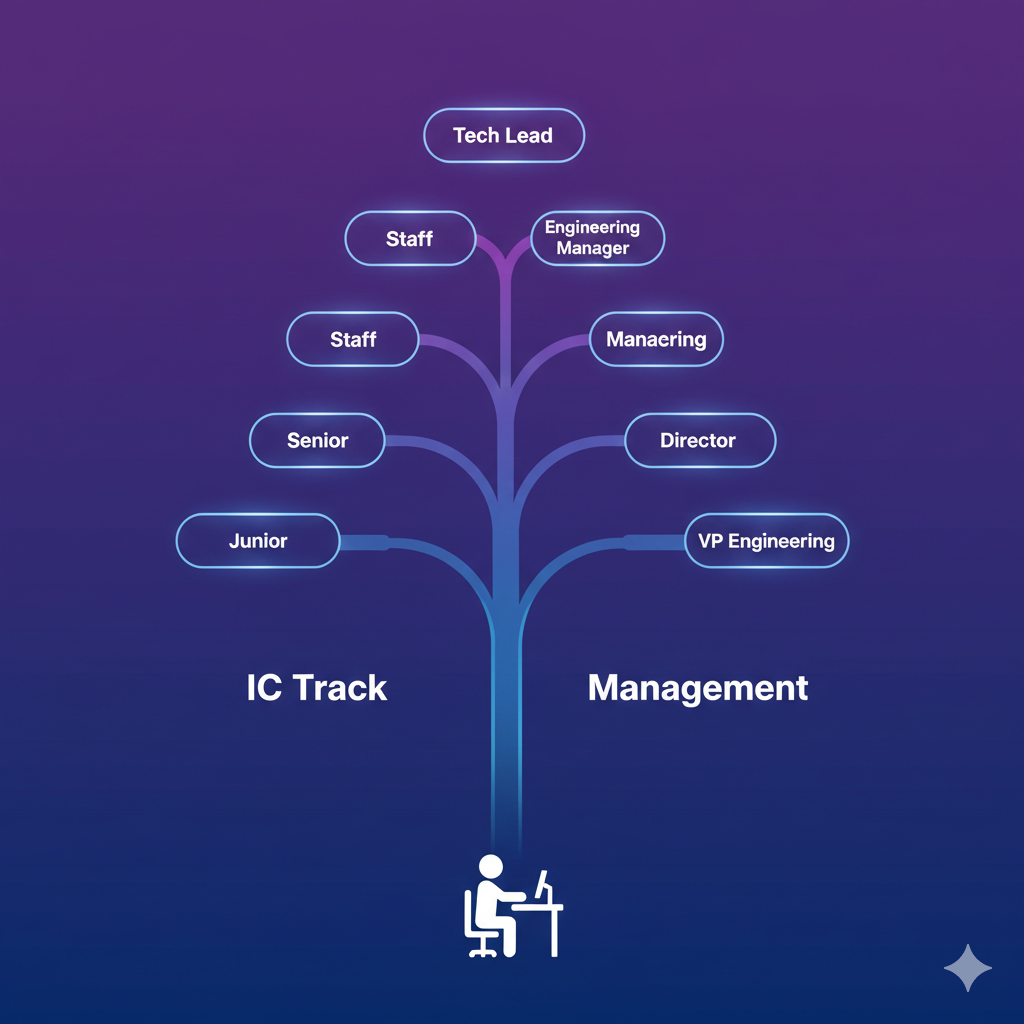
R.03 Developer Career Paths in 2026 — IC, Management, and Everything In Between
Sponsored
The dispatch
Working notes from
the studio.
A short letter twice a month — what we shipped, what broke, and the AI tools earning their keep.
Discussion
Join the conversation.
Comments are powered by GitHub Discussions. Sign in with your GitHub account to leave a comment.
Sponsored